
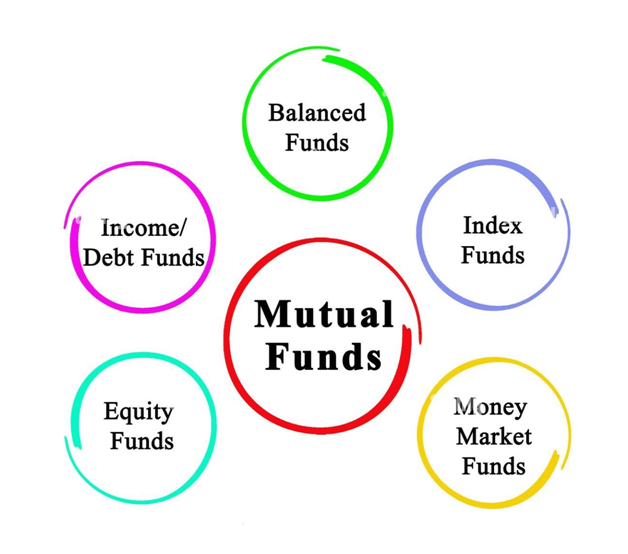
There are several types of mutual funds in India classified by asset class, investment goals, and structure, each catering to different investor needs and risk profiles.
Based on Asset Class:
- Equity Funds: Primarily invest in shares of companies, aiming for long-term capital appreciation.
- Debt Funds: Invest in bonds and other fixed-income securities, offering lower risk and steady returns.
- Hybrid Funds: Combine equity and debt exposure, balancing growth and stability.
- Commodity Funds: Invest in commodities like gold or silver.
- Money Market Funds: Focus on low-risk, short-term securities for liquidity.
Based on Structure:
- Open-ended Funds: Can be bought and sold any time, offering higher liquidity.
- Close-ended Funds: Have fixed maturity and limited subscription periods.
Based on Investment Goals:
- Growth Funds: Focus on capital appreciation through equity investments.
- Income Funds: Invest in bonds or dividend stocks for regular income.
- Liquid Funds: Invest in short-term debt instruments for quick access to funds.
- Tax Saving Funds (ELSS): Provide tax benefits under Section 80C, with equity-focused portfolios.
- Aggressive Growth Funds: Target high returns with higher risk exposure.
- Capital Protection Funds: Aim to safeguard principal with modest returns.
- Fixed Maturity Funds: Have a set maturity date for stable returns.
- Pension Funds: Designed for retirement corpus, with a mix of assets.
Other Types:
- Index Funds: Track a benchmark index for passive investment.
- Sectoral/Thematic Funds: Focus on specific industries like technology or healthcare.
- Gilt Funds: Invest solely in government securities for high safety.
- International Funds: Invest in global equities or bonds.
- Solution Oriented Funds: Structured for specific goals, like retirement or child education.
These categories help investors select mutual funds that match their risk tolerance, investment horizon, and financial objectives.